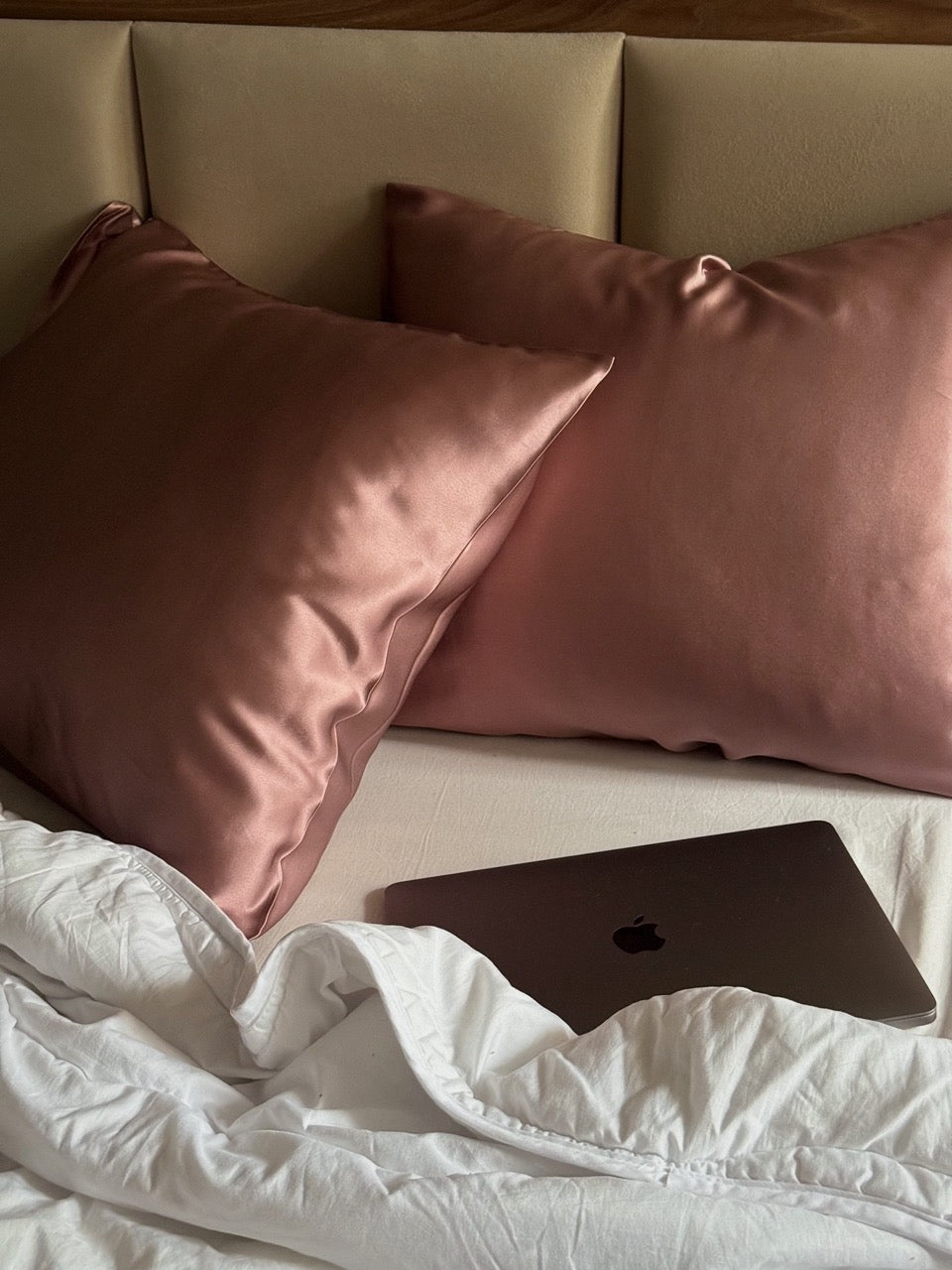
Silk pillowcases are becoming increasingly popular because of their superior properties - not only do they offer a feeling of comfort like no other material, but they also have real and practical benefits for the skin and hair. However, in order to make a successful investment and meet your expectations, it is important to know a few important details before making a purchase of your silk pillowcase.
Type and quality of silk
The quality of a silk is determined by its fibres and the method of production. The most popular and high-quality silk for pillowcases is Mulberry silk, known for its softness, durability and smooth texture. It is very important that the silk worms and mulberry trees grow and live in natural conditions - without chemicals to speed up the process - because only then does the silk fibre itself retain all its natural functions.The next important detail is the type of silk weaving, the most popular being satin or charmeuse.Although they look very similar, the charmeuse weave gives a more natural sheen as well as maximum softness to the touch, which is why all our silk pillowcases are woven in charmeuse.And most importantly, pay attention to the Momme value of silk - a measure of its density and quality. We recommend silk pillowcases with a Momme value of at least 22 Momme - below that the fabric is noticeably thinner and wears out faster. At our e-store SilkWide every silk pillowcase is woven from 23 Momme mulberry silk.
Natural properties for skin and hair
Silk pillowcases offer several benefits:• Less friction: helps reduce breakage and knots.• Moisture-retaining properties: silk does not draw moisture away from the skin and hair, helping to prevent dry skin and dry hair.• Anti-allergenic properties: natural silk is hypoallergenic, suitable for people with sensitive skin.
Care of silk
Silk is a very delicate material, but easy to care for at home:• Silk pillowcases can be safely washed in the washing machine, the main thing is to do it in the "Silk" or "Delicate" mode and add the appropriate detergent for silk.• It is important to avoid tumble drying - silk must be dried naturally, otherwise it will permanently damage its structure, making it rough.• After drying, the silk must be ironed to restore its shine and softness - this can be done either with a conventional iron or with steam, the key is to set the temperature low so as not to damage it.
A silk pillowcase is not only a luxurious and elegant accessory for the night, but also a practical solution for healthier skin and hair. We can only recommend that you try a silk pillowcase on your own skin to really see for yourself.Choose your silk pillowcase on our e-store from 10 available colors and 3 different sizes!